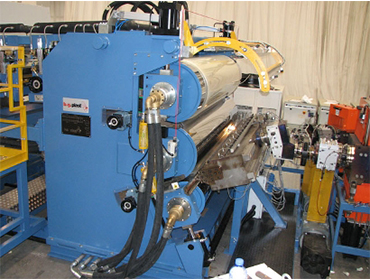
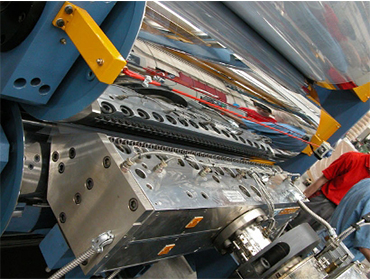
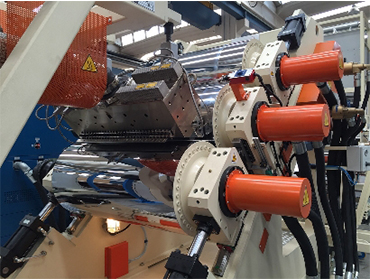
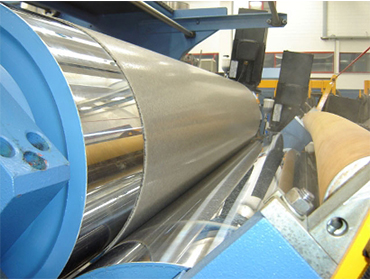
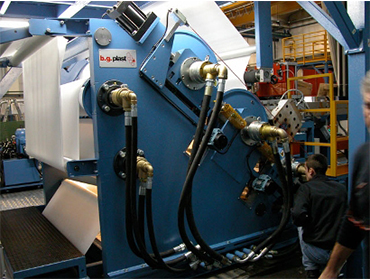
BG Plast has specialized in designing and manufacturing calenders for the production of thermoplastic materials. These machines are the core of the extrusion process for the production of films and sheets. Features include a precision electromechanical control on roll opening and closing which guarantees thicknesses from 0.1 to 40 mm, depending on material.
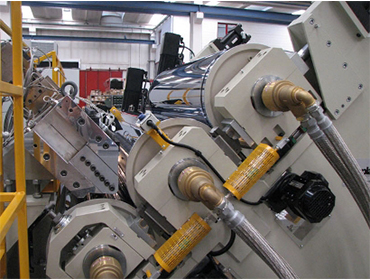
Closing force expressed in kg/cm is different according to type of polymer, being set by the size of the hydraulic pistons used for moving the rolls (between 80 and 120 kg/cm). A separate thermoregulation unit controls water/oil flow and temperature for each roll. Independent motor-reducer drive for each roll. In case of very thin sheets there is a particular device called “cross-axis”, shifting the lower roll shaft in relation to the other rolls, to improve thickness regulation. This proves to be quite useful to assure uniformity of sheet thickness.
Sizes of BG Plast manufacturing lines and calenders vary according to the final product required by the customer. The witdh range of calender roll stacks goes from 450 mm to 4800 mm. Thanks to different type of feed-block configurations, BG Plast has faced several co-extrusion applications using up to 7 extruders.
BG Plast has specialized in designing and manufacturing calenders for the production of thermoplastic materials. These machines are the core of the extrusion process for the production of films and sheets. Features include a precision electromechanical control on roll opening and closing which guarantees thicknesses from 0.1 to 40 mm, depending on material.
Closing force expressed in kg/cm is different according to type of polymer, being set by the size of the hydraulic pistons used for moving the rolls (between 80 and 120 kg/cm). A separate thermoregulation unit controls water/oil flow and temperature for each roll. Independent motor-reducer drive for each roll. In case of very thin sheets there is a particular device called “cross-axis”, shifting the lower roll shaft in relation to the other rolls, to improve thickness regulation. This proves to be quite useful to assure uniformity of sheet thickness.
Sizes of BG Plast manufacturing lines and calenders vary according to the final product required by the customer. The witdh range of calender roll stacks goes from 450 mm to 4800 mm. Thanks to different type of feed-block configurations, BG Plast has faced several co-extrusion applications using up to 7 extruders.
The main extruder, with bimetallic barrel and screw, has been specifically designed for PC processing, mainly in what concerns the efficiency of the venting system. The gravimetric high precision dosers guarantee constant feed rates synchronized with the gear pump and the extruder screw rpm.
The co-extruder is extruding a thin layer suitable to protect the sheet against UV rays.
It is well known how critical is for the calendering system to obtain high optical quality sheets: in the 3-roll calender BG Plast engineers have applied the best mechanical and technological solutionts. The calender has three rolls of 410 mm diameter with high gloss finishing on surface with internal circulation of pressurized water flow at high temperatures.
The total width of the rolls is related to the final net width of the sheet. Standard width for this type of machine is 2300 mm for net width on sheet of 2000 mm.
The calender geometry can be varied: the upper roll turns around the central roll axis. This particular feature permits to adapt the calender to the thicknesses required for the sheet.
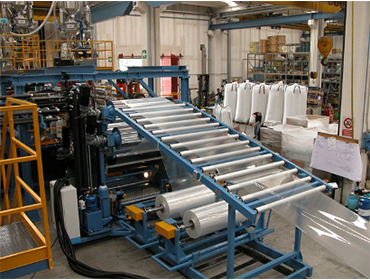
Roll speed transmission, motor and reducer controls have been particularly studied to guarantee a rotational movement with absolutely no vibration, an unavoidable factor to get the properties required by optical quality sheet. The extruded sheet is later protected with polyethylene film and cut to size up to 3000 mm length. An automatic vacuum sucker unit picks up the sheets and stacks them at the side. Different configuartion available upon request.
For a long time any attempt to obtain PC sheet under 0.8 mm thick was hindered by the difficult task of the process involved. Since the market required such application, BG Plast engineering team concentrated their efforts in order to produce a calender able to make calibrated sheet of optic quality having 0.5 mm minimum thickness.
This was made possible using strong rolls with high closing force and an exceptional control of thermoregulation flow rates.
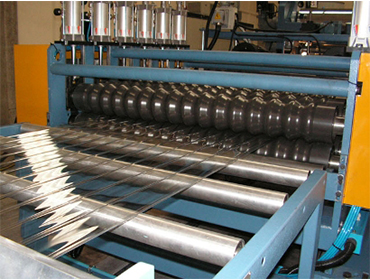
After the calendering stage the PC sheet, co-extruded with an anti-UV layer, passes through a controlled softening oven before entering the shaping stage which consists in a metal alloy rolls stack. Rolls are thermically controlled and shaped according to the contour design required for the sheet.
The shaping assembly can be easily dismounted to allow a prompt substitution of the rolls. The line is completed with a special haul off unit, easily adaptable to the different sheet contours, and a cut-off group with automatic stacker which facilitates placing the sheets on suitable platforms, ready for shipment.
In order to help water flow and to ensure long-lasting use, large sized concrete pipes are usually lined inside with ceramic tiles.
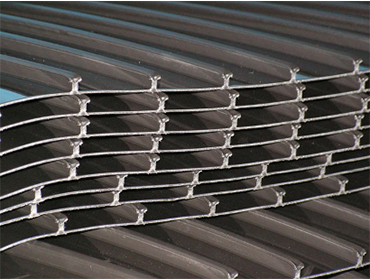
To avoid high production costs a HDPE sheet application has been devised as inside lining. This sheet has a particular profile which allows its installation and anchoring in the concrete at the time of the casting process, by means of a series of longitudinal T's.
This means that the inside of the concrete pipe is indeed like the inside of any standard HDPE pipe, with all resulting advantages.
This particular HDPE sheet is manufactured using a special calender with contoured rollers which produce the longitudinal T's. A highly efficient cooling system enables to obtain sheets up to 4 mm thick, a thickness not to be found in the market so far.
BG Plast is poroposing also different geompetries instead of T shape. This is according to customer request.
It's well known the importance of being able to use lowest possible cost materials in order to reduce product selling prices – and what is less costly than the simply washed and milled recycled material?
But it's also true that reclaim plastics contain fat and soaps that will not favour the extrusion process at all.
Therefore it was necessary for our engineering team to develop a special technique combining carefully dosed flakes feeding, intensive venting stage by means of high capacity vacuum pumps and an extrusion screw suitable to stand the high yields required.
Using recycled material implies also the presence of dirties that if remain, bearing in mind the minimum thickness required, would unavoidably cause the so called "holes" in the sheet, making it useless for its final application.
Therefore, the melt filtering stage has required the use of a large battery of screen changers, rather impressive but wholly reliable, since it grants the removal of minimum damaging particles.
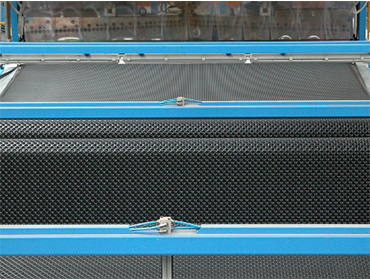
The assembly is completed by a suitable gear pump which ensures constant feeding to the 4400 mm width extrusion head. The extruded product goes over a special alloy roll having over 16.000 studs made of highly conductive alloy material.
This is the core of the whole process, since this special calendering produces the dimpled sheet. It is quite important for the rolls to have a perfectly efficient cooling system, a point that has been thoroughly studied by our process engineers. Of course, BG Plast can prepare machines getting similar productions using granulated material, either virgin or reclaimed, instead of flakes. This would certainly simplify the mechanical issue related with polymer transformation, since less resources would be necessary from the point of view of both power required and initial investment.
PVC sheet extrusion lines always attract attention, be it rigid, flexible or foamed. PVC processing is a difficult task, this polymer requires to comply with specific rules from the beginning in order to design the most efficient manufacturing procedures.
Those rules make part of BG Plast engineering know-how, acquired through many years of hard research and experience. Today BG Plast is ready to provide machinery to meet particular demands of the market such as: Non Toxic PVC Cling Film for Food packaging (blow film extrusion) – Rigid PVC Film for Credit Cards (up to 250 microns) – Acrylic/PVC Sheet for the Aeronautical Industry (inside of Airbus) – Non Toxic Plastified PVC Film for Medical Collection Bags (up to 850 microns) – Low-Free-Foam PVC Sheets, 1 to 20 mm thick (higher thicknesses on request) – Foamed PVC Co-extruded Sheets – Rigid PVC Sheets for General Application (embossed. glazed, etc.)
In recent years the demand for using PET bottle waste to produce also thermoformed sheet has been growing steadily. Several technologies were applied, all of them trying to avoid drying of flakes (with relative high costs) before being fed to the extruder. In order to keep manufacturing costs down, BG Plast has prepared a single screw extruder equipped with a gravimetric dosing unit, falkes, virgin material and masterbatch.
The sheet thus obtained guarantees high quality, with a minimum loss of I.V. (Intrinsic Viscosity) measured in the extruded sheet in relation to initial waste values.
It is well known how strongly moisture influences the I.V. of the PET product to be later thermoformed. Such moisture can be thoroughly eliminated by means of a very efficient vacuum system equipped with a high performance special pump.
The use of the sheet for food packaging requires that only virgin material may have contact with foodstuffs.
Therefore the central extruder, fed with flakes, is complemented by a co-extruder to be fed with virgin material.
This allows the production of a multi-layer sheet A-B-A in a 5-90-5% ratio, respectively.
Downstream equipment is similar to that of a PP or PS sheet standard line, with the addition of a silicon bath along the extrusion line.
In order to be competitive from all points of view, BG Plast has recently close an important agreement with a well known European manufacture of twin screw co-rotating extruders.
Polywood is a manufacturing patented process, studied and developed by BG Plast engineering team through the years.
Polywood process combines wood sawdust with a polymer resin blend to produce sheets of various thicknesses and lengths. These materials are processed in one or two extruders by co-extrusion, followed by a calendering stage of extreme precision in terms of width and thickness. Percentages of materials used vary depending on the mechanical features required for the final application. The usual ratio is 50-50 although it is possible to reach even 80% wood sawdust and 20% polymer. Polymer used is in most cases regenerated polypropylene, an economical advantage of this process.
Besides several applications in building and packing fields, the product is largely used also by the automotive industry. Almost all car manufacturing companies choose Polywood to manufacture the car doors, this because Polywood sheets can be thermoformed and coupled with a non woven layer which gives the surface a high quality finish.
A further advantage of Polywood is that it can be recovered. As a matter of fact, once milled and ground to fine particles it is possible to reuse it 100% for similar applications.
For many years BG Plast engineers have achieved great success in the production of coating lines. There are many possibilities for combining plastics with other materials such as nonwoven fabrics, moquette, natural fibres, etc.
They are widely used in a variety of fields, from the automotive industry to that of shoes manufacturing and even the fair and exhibition market, to which were supplied 4000 mm width moquette rolls.
A new recent experience was a combination of 6 layers of which 3 of different polymers and 3 of natural fibres. The line produces rigid panels to be thermoformed as car doors.