For advertising, divider panel for applications that are not subject to loads, roofing. The sheets can easily be bend even if it is cold.
Ideal to be used for roofing for 2 reasons: strong resistance when it hails, and excellent thermal insulating properties.
The side of the plate with UV protection, applied during extrusion process, should be install outside on top.
Recent successes in this field has allowed to BG PLAST to create plants with higher production capacity while maintaining the quality of the sheet within the limits imposed by the market!
After years of studies and numerous plants built, BG Plast has reached a high level of quality and become a reference for those wishing to enter in this type of production.
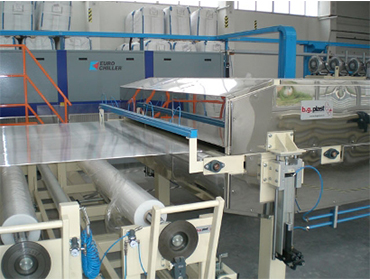
BGBoard 2200 is a line for the production of multiwall sheet made of PP homopolymer / copolymer useful with 2200 mm. The peculiarity of the line is the type of extruder: for the first time in the world it has been used a twin-screw counter rotating extruder with screw diameter of 125mm to produce PP Hollow sheet!
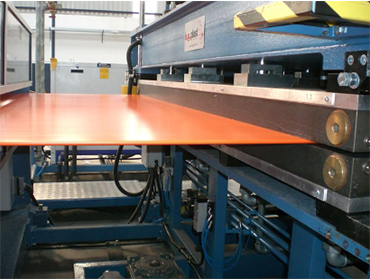
Thanks to the peculiarities of this extruder it is possible to obtain a higher production rate with all type of thickness of sheet without degrading too much the polymer, with a significantly lower consumption of the plant (almost 1 / 3 less than the installed capacity just for 'extruder!). A further update was done in the calibration unit, fully automatic, with opening and closing automatic fine adjustments in a range decimals.
All film converting operations result in trim and other waste. This is quite voluminous and difficult to dispose off. If the waste is of a single type, e.g., LDPE or BOPP or simple mixtures such as LDPE + HDPE it can be easily reprocessed.
However, when it is a laminate waste such as PET/PE (Polyester film laminated with LDPE) recycling is not possible. In such cases incineration is the usual method but it leads to heavy smoke generation resulting in atmospheric pollution.
PPMPL have developed a process to recycle such waste. The process is ideally suited to Indian conditions and no imports of any type are involved.
Products/Applications Currently the following extruded products are considered feasible: flooring, sheets for architectural uses, e.g., office partitions, roofing – corrugated and therwise, slats for benches and chairs and generally any extruded sections needing mechanical load bearing capacity similar to aforesaid applications. The resulting product has mechanical properties intermediate between General Purpose Polystyrene and HIPS.
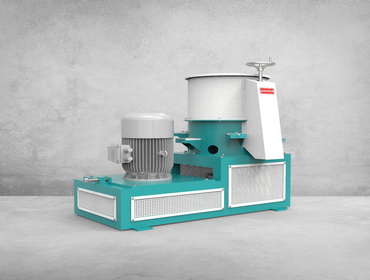
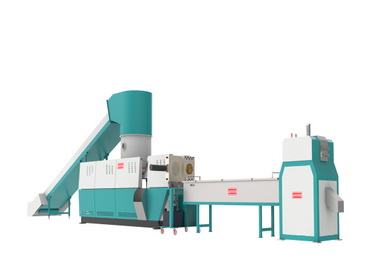
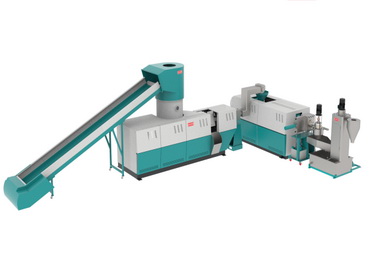
Process Basically, the process involves (1-stage) Compaction of the waste by agglomeration / grinding / shredding followed by extrusion. (2-stage) Dry the granules, mix with the bonding/compatibiliser and other additives. (3-stage) Extrusion into final usable shapes. (4-stage) Lamination for decorative finish. Depending upon the application and type of waste a filler or other additives may be added in stage (2-stage) along with bonding/compatibiliser. Use of a compatibilizer and the control of process parameters is the key to the successful operation of the technology. The compatibilizer has also been developed indigenously and this has kept the cost of the whole process low.
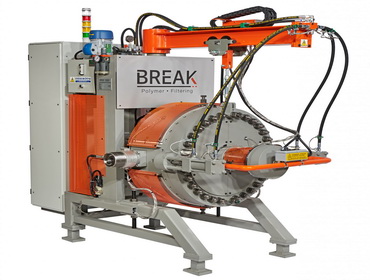
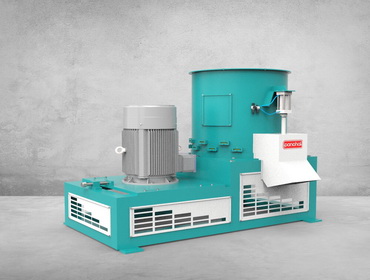
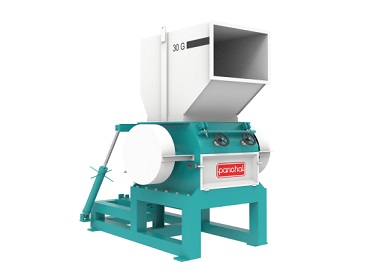
Due to the presence of all kinds of inks in the PET/PE film laminate waste available from conversion industry, the final colour of the product from this reprocessed material islikely to be dark (e.g., dark green/grey/black). Some further colour variation may be brought about by the presence of metallised film in the waste. Major pieces of machinery are listed below: Shredder / Agglomerator / Grinder Machine Dryer Mixer/Blender Extruder (profile/sheet)
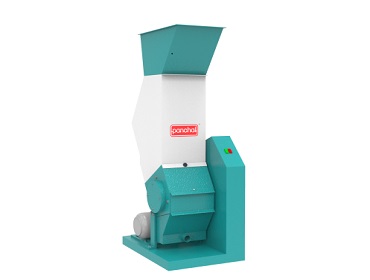
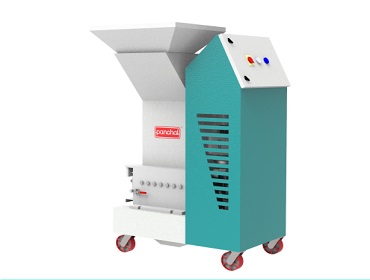
Beside-The-Press Series granulator are ideal for the processor who has small injection molding machines and wants a lot of value in a small package. This quiet, energy efficient granulator conserves valuable floor space while producing quality regrind from robot-fed sprues, runner and small parts. All models feature tangential feed, case hardened cutting chambers, low-speed motor and staggered rotors with replaceable cassette knives. The staggered rotor design produces more cuts per revolution, resulting in higher throughput. Smaller bites reduce the chance of jamming or shearing. The scissor cutting action of slanted cassette rotor knives produce superior quality regrind. The staggered rotor, combined with a low-speed motor, offers cleaner, quieter cutting and uses less energy.